

Quebec Bill 16 & Maintenance Log:
what your condo board must know
Last updated on September 11, 2026
Bill 16 transforms condo management in Quebec. Mandatory maintenance log, strengthened contingency fund, new board responsibilities, here is what Bill 16 asks of a volunteer board, and in what order.
A practical guide, for information only. It does not replace legal advice.
Start for freeWhat is Quebec Bill 16?
Adopted in December 2019 by Quebec's National Assembly, Bill 16 amends the Civil Code of Québec to strengthen the governance of divided co-ownerships (condominiums).
Its primary goal: protect co-owners by requiring syndicates to document the state of the building and to fund its upkeep.
Bill 16 applies to all divided co-ownership syndicates in Quebec, whether a 4-unit building or a complex of hundreds of condos.
The 3 key obligations of Bill 16
1. The maintenance log
A complete inventory of all building components (roof, plumbing, elevators, etc.) with their condition, estimated useful life and work history.
2. The contingency fund study
An analysis by an engineer, chartered appraiser, architect, professional technologist or CPA, a member of their order and independent from the syndicate, at least every five years, to set contingency fund contributions from the building's actual condition.
3. Telling co-owners where things stand
The financial statements presented at the annual meeting, the syndicate certificate handed over at every sale (art. 1068.1 C.C.Q.), and what co-owners need to know about the state of the contingency fund.
The maintenance log in detail
The maintenance log is the most operationally demanding obligation of Bill 16. It must be kept current and accessible to co-owners on request.
What must the maintenance log contain?
The regulation (order in council 991-2025, s. 2 and 3) sets the contents. In plain terms:
- An inventory of the common portions: structure, roof, windows, mechanical and electrical systems, plumbing, elevators, common areas.
- For each component, the date it was installed or last replaced, and its condition.
- The work carried out, with dates, and the work that was put off.
- The service contracts in force and the warranties still running.
- The inspection reports and expert assessments.
- A projection of the work and its cost over twenty-five years.
Who is responsible for the maintenance log?
The co-ownership syndicate, represented by its board of directors, is legally responsible for creating, updating and maintaining the log. In practice, this is often managed by the property manager or a designated board member.
What happens without a log?
We found no fine, neither in Bill 16 nor in the regulation. What happens sits elsewhere, and it shows:
- At the next sale, a syndicate certificate the board cannot fill in.
- A contingency fund study that cannot be done: it starts from the condition of the components, which the log documents.
- After damage tied to undocumented upkeep, a board's liability that is harder to defend.
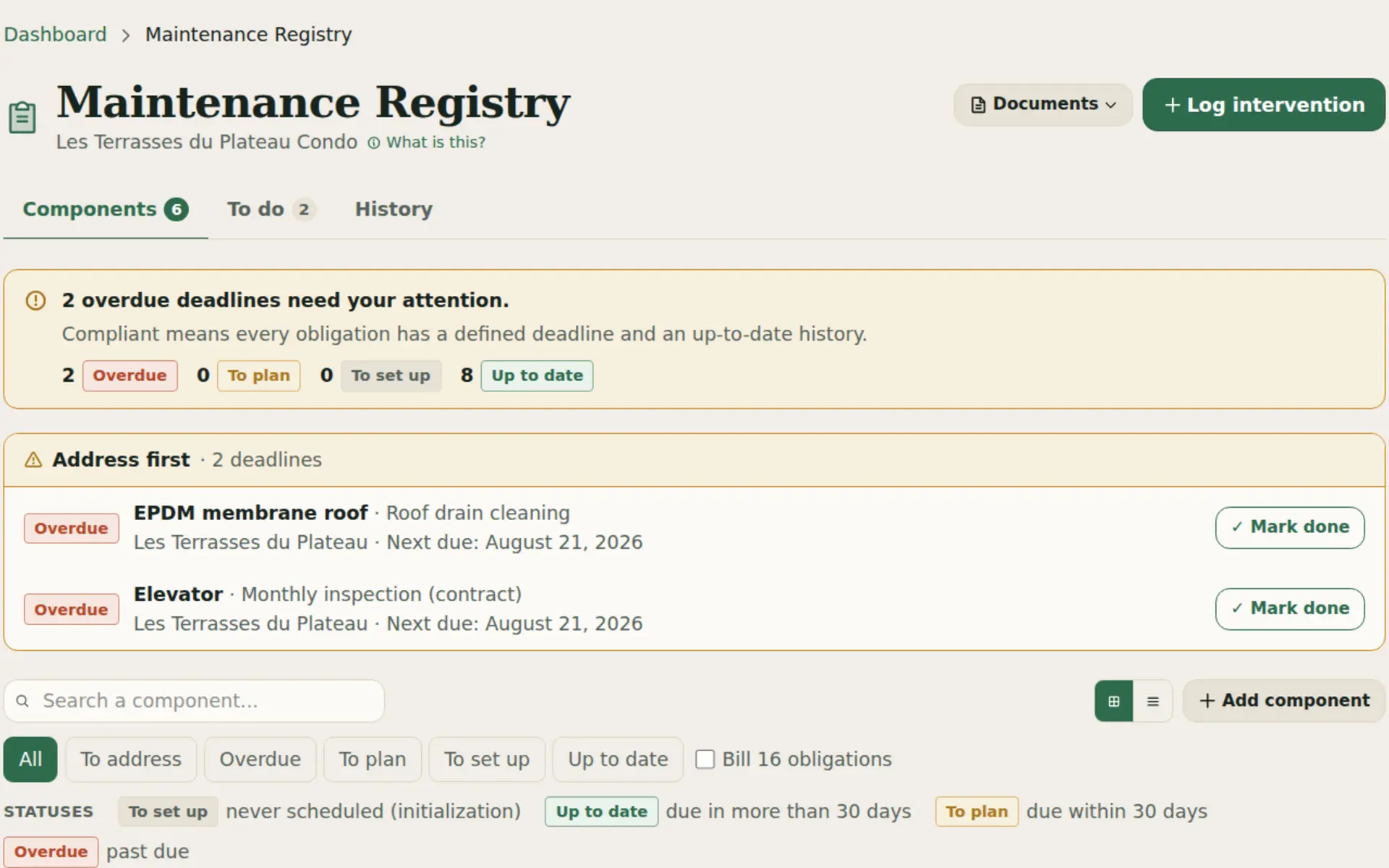
Who draws up the maintenance log?
The log is drawn up by a qualified person: a member of Quebec's order of engineers, chartered appraisers, architects or professional technologists, independent from the syndicate (Order in Council 991-2025, s. 1).
From there, the work is shared:
- The review belongs to a qualified person, every five years, ten for small buildings (s. 5).
- Keeping it current belongs to the board, which records each year the work done and the work postponed (s. 4).
- The contingency fund study is done by the same professions, or by a chartered professional accountant (s. 7), at least every five years (s. 8).
Kohabit is for keeping it current: the interventions, the invoices, the documents, and the export when someone asks for it. It does not draw up the log and does not replace the qualified person.
A volunteer board's realistic backward plan
From the first box of documents to the August 15, 2028 deadline, without the scramble.
Gather
Centralize everything that exists: declaration of co-ownership, plans, past inspection reports, major-work invoices, maintenance contracts, warranties. Don't sort yet, just gather. If your documents live in three boxes, two email inboxes, and a USB stick at the former treasurer's home, now is the time to bring them into one place.
Build
Have the component inventory and their condition established. Depending on the building's size and complexity, this means a building professional who inspects and documents. Request quotes now: lead times stretch as 2028 approaches.
Tool up and settle in
Set up the maintenance schedule and build the habit of recording each intervention as it happens. Six months of run-in before the deadline leaves time to adjust frequencies and train the next board.
The log exists
2028: the log exists, it is current, and the contingency fund study builds on it.
The mistakes we see most often
Waiting for the deadline
Syndicates that document now turn an obligation into an advantage: better budget planning, smoother sales thanks to an up-to-date certificate on the condition of the co-ownership, better-negotiated insurance.
Entrusting the log to a single human memory
The devoted treasurer's Excel file works right up until the day they move away. The log must outlive individuals: it is a record of the syndicate, not of a person.
Having it built, then never touching it again
A log frozen in 2027 will be outdated by 2029. The value is in day-to-day upkeep, which takes a few minutes per intervention when the tool fits.
Paying for what you can do yourselves
A professional's expertise is valuable for the initial inventory and the reviews; the daily data entry is yours. Be wary of packages that bill routine upkeep at expert rates.
The contingency fund study: what changes
Before Bill 16, many syndicates set contingency fund contributions arbitrarily, often too low, leading to brutal special assessments the day a major repair was needed. Bill 16 now requires a contingency fund study done by a qualified person.
How often?
The study must be conducted every 5 years at minimum. It uses the current component condition (from the maintenance log) to project replacement costs over 25 to 30 years.
Who performs it?
An engineer, chartered appraiser, architect, professional technologist or CPA, a member of their order and independent from the syndicate. Typical cost: $1,500 to $5,000 depending on size.
What if the fund is underfunded?
If the study reveals the fund is insufficient, the syndicate must increase contributions. The longer you wait, the more brutal the increase. That's why acting before 2028 matters.
When a unit is sold
A co-owner sells. They ask the syndicate for the certificate on the condition of the co-ownership, the document the notary wants. The board has fifteen days to produce it (art. 1068.1 C.C.Q.).
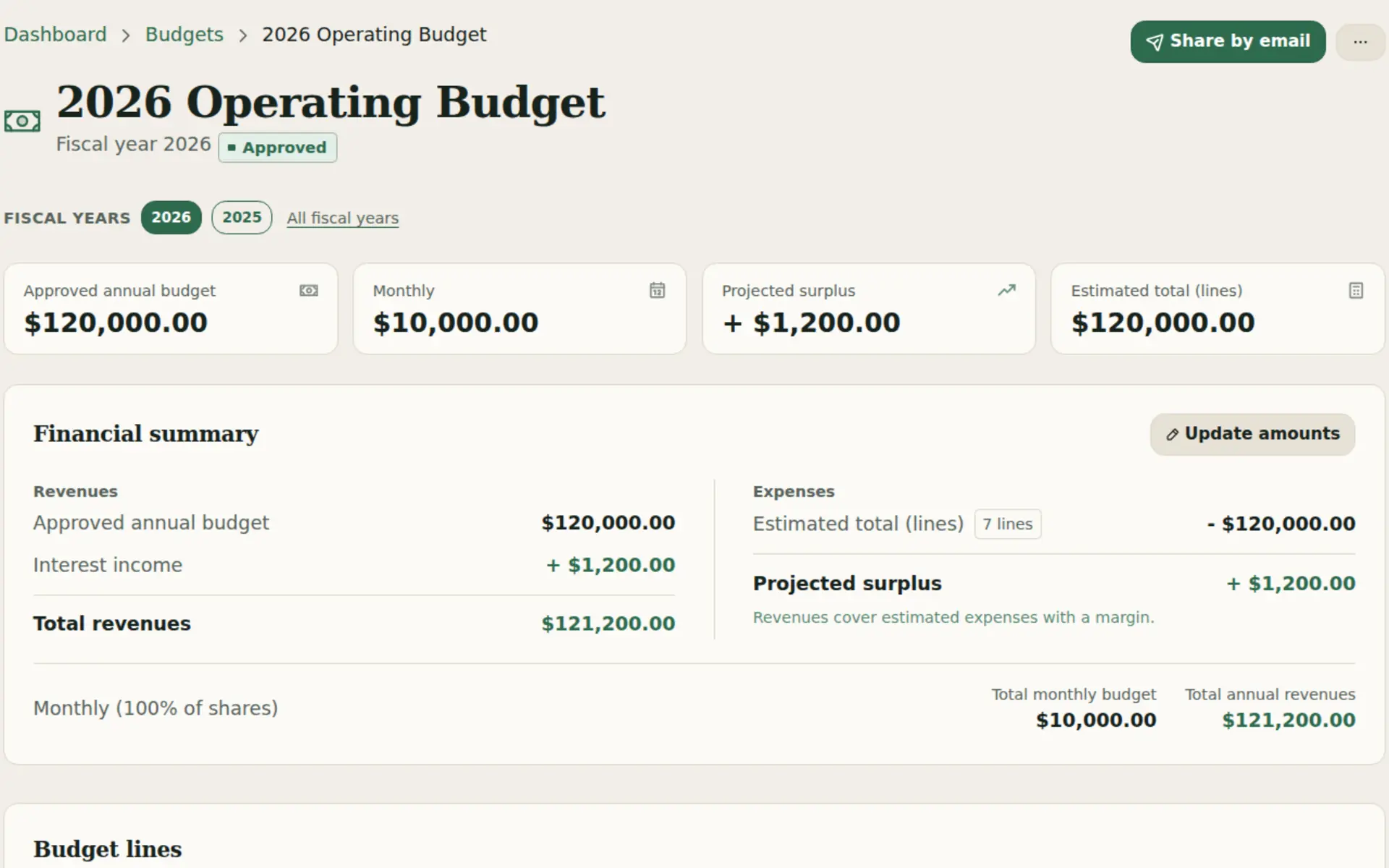
Among other things, the certificate states the contingency fund balance and the amount the study says should be there. The gap between the two reads in one line, by the buyer as much as by their notary.
A log kept as the work happens gives those figures the day they are asked for. Without it, the board looks for them at the same time as the buyer. Kohabit has a free certificate generator, and an annotated template.
Bill 16 in the broader Canadian context
Quebec is not the only Canadian province to have reformed its condominium framework in recent years. Understanding how Bill 16 compares to other provincial regimes helps you measure its ambition and anticipate where regulation is likely heading.
| Province | Governing law | Log / study required? | Update frequency |
|---|---|---|---|
| Quebec | Bill 16 (2019), amending the Civil Code | Yes: maintenance log + contingency fund study | Study every 5 years |
| British Columbia | Strata Property Act (1998) | Yes: Depreciation Report (equivalent) | Every 3 years |
| Ontario | Condominium Act (1998), Bill 106 (2017) | Yes: contingency fund study | Every 3 years |
| Alberta | Condominium Property Act | Yes: contingency fund study | Every 5 years |
How much does it cost?
Costs vary too much from one building to another to give a single honest number, but the structure is predictable: an initial cost for the component inventory and condition assessment, periodic reviews, and a day-to-day upkeep cost that should be close to zero if you are properly equipped.
Ask for two or three quotes for drawing up the log and for the study: that is the only figure that means anything for your building, and it comes back quickly.
How Kohabit gives you the tools to keep the log
Bill 16 requires a maintenance log kept up to date. Kohabit gives you the tools to keep it: the module guides you to create the register, record each intervention and export it. It is included in every plan, at no extra cost.
Guided asset inventory
Build your inventory with our step-by-step wizard. Categories that follow the Bill 16 regulation (structure, mechanical, electrical, and the rest).
Maintenance task tracking
Schedule and document every intervention. Automatic reminders for periodic maintenance.
Permanent history
Every intervention is recorded with its date, its contractor, its cost and the attached documents.
PDF export
Generate a structured PDF report of your maintenance log for your AGMs, notaries, and archiving.
Bill 16 rollout timeline
Bill 16 was adopted in 2019, but its provisions came into force in stages. Here are the key dates to keep in mind:
-
Dec. 2019
Bill 16 adopted
Quebec's National Assembly adopts Bill 16, amending the Civil Code provisions governing divided co-ownerships.
-
Jan. 2020
First provisions in force
The first provisions come into force, notably around the disclosure of information to buyers during a sale.
-
2020 to 2025
Phased-in obligations
Progressive rollout of the maintenance log and contingency fund study obligations. Existing syndicates were granted transitional deadlines. New syndicates are subject to the new rules immediately.
-
August 14, 2025
The regulation comes into force
Order in Council 991-2025 sets what the maintenance log must contain, who draws it up and how often it is reviewed. The deadline for existing co-ownerships runs from this date.
-
August 15, 2028
The deadline for existing co-ownerships
Québec.ca gives syndicates "three years and a day" from the regulation coming into force, which lands on August 15, 2028.
Bill 16 glossary
Condominium law is full of specific terms. Below are definitions of the main concepts used in this page and in official Bill 16 documents.
- Divided co-ownership (copropriété divise)
- Ownership regime where each co-owner exclusively owns a private portion (their condo unit) and a share of the common areas (roof, hallways, elevators, etc.). This is the regime Bill 16 applies to. Distinct from undivided co-ownership, where no portion is exclusive.
- Syndicate (syndicat de copropriété)
- Legal entity created automatically with the declaration of co-ownership. It groups all co-owners and is responsible for preserving the building. The syndicate is bound by Bill 16 obligations, not individual co-owners.
- Maintenance log (carnet d'entretien)
- Living document that lists building components, their condition, useful life, and maintenance history. Required under Bill 16, it serves as the reference for the contingency fund study and for real estate transactions.
- Contingency fund (fonds de prévoyance)
- Financial reserve built by co-owners to fund major repairs and replacement of common elements. Distinct from the operating fund, which covers ongoing expenses (insurance, cleaning, etc.).
- Contingency fund study
- An analysis projecting component replacement costs and setting the contribution level. Done by an engineer, chartered appraiser, architect, professional technologist or CPA, at least every five years.
- Declaration of co-ownership
- Founding notarized deed of the divided co-ownership. Defines common and private portions, the relative value of each fraction (the voting share), and shared living rules. The reference document for any legal question about the building.
- Voting share (relative value of the fraction)
- A unit's weight in the co-ownership, set in the declaration from the nature, area and location of the fraction. It determines the share of the common expenses and the voting weight at a general meeting. "Thousandths" is French usage; the Quebec declaration speaks of relative value.
- Annual general meeting (AGM)
- Yearly meeting of all co-owners where key decisions are made: budget approval, board election, voting on major works. The notice period comes from the Civil Code (art. 346), not from Bill 16.
- Special assessment (cotisation spéciale)
- Exceptional capital call decided by the syndicate to fund an unforeseen expense beyond the contingency fund's capacity. Avoiding this is precisely what Bill 16 aims for by requiring rigorous financial planning.
Frequently asked questions about Bill 16
Official sources and resources
To go straight to the source, here are the official Quebec references on Bill 16 and condominium syndicate obligations.
Civil Code of Québec, articles 1039 to 1109
Full text of the divided co-ownership provisions on LégisQuébec, the official Quebec legislation portal.
Régie du bâtiment du Québec (RBQ)
Regulatory authority overseeing building inspector certification and building safety in Quebec.
OACAPQ
Organization of Accredited Condo Administrators of Quebec, resources for board member and administrator training.
CondoLégal
Reference resource on divided co-ownership law in Quebec, with case law and Bill 16 analysis.
Note: these external links open in a new tab. Kohabit is not affiliated with these organizations.
Go further
Explore our practical guide for Quebec condo boards.
August 15, 2028: your board's countdown
What has to be ready before the deadline, and how long each step takes.
Certificate on the condition of the co-ownership
Bill 16's third obligation, to be produced within 15 days of a request during a sale.
How to manage a small volunteer condo board
A step-by-step playbook to run a volunteer syndicate without prior technical expertise.
Why host your data in Canada?
Sovereignty, the CLOUD Act and Law 25: what every board should know before choosing a tool.
The log, as the work happens.
60 days to try it, no card.
Start for freeNo credit card required · Cancel anytime